How Does CAPTCHA Work?

Lucas Mitchell
Automation Engineer
TL;DR
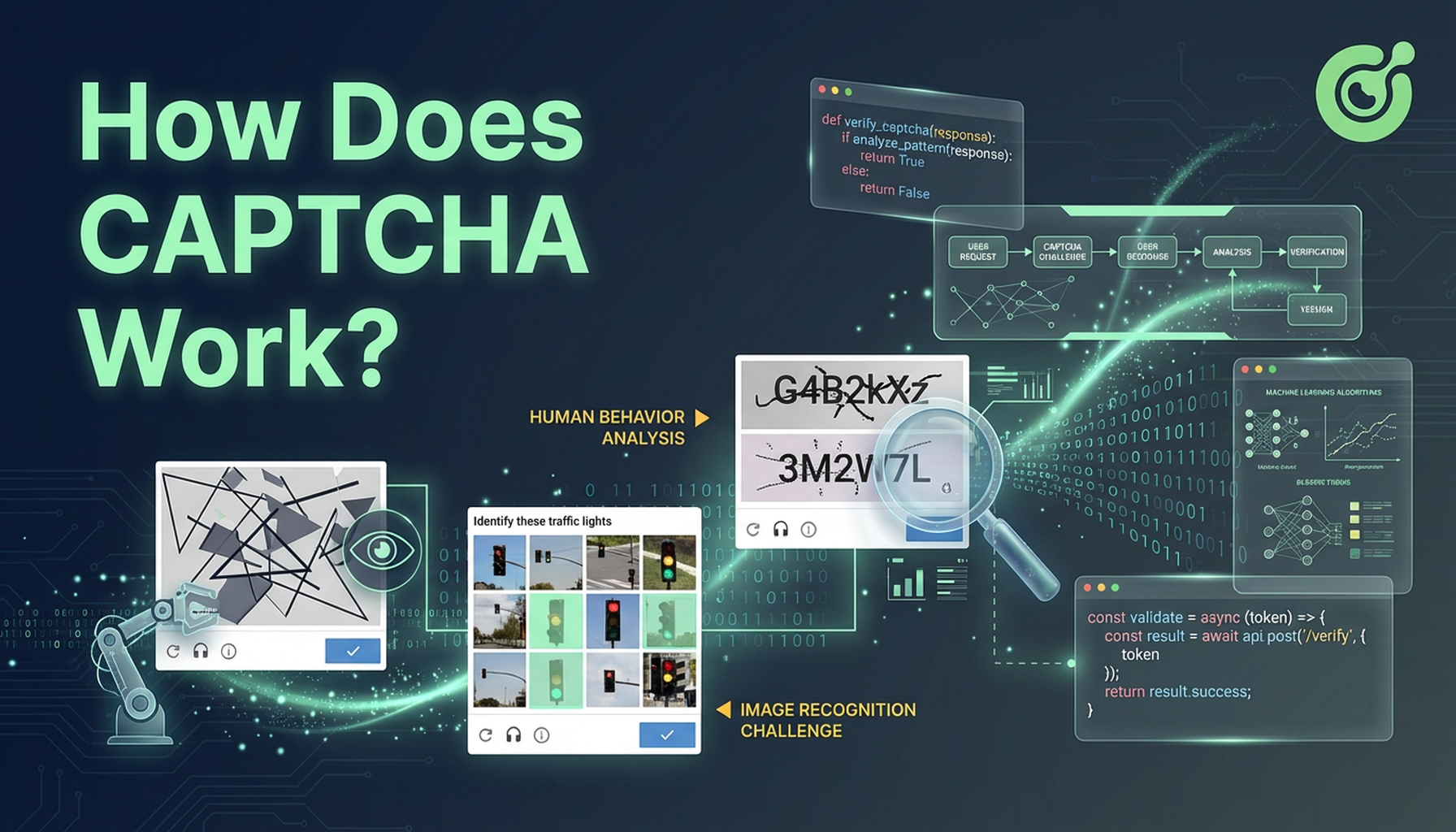
CAPTCHAs are security mechanisms designed to distinguish humans from automated bots by presenting challenges that are easy for people but difficult for machines. Based on the principles of the Turing Test, CAPTCHAs have evolved from distorted text to advanced systems like Google reCAPTCHA, which combines image recognition, behavior analysis, and machine learning. While essential for web security and abuse prevention, CAPTCHAs can impact user experience and accessibility and are not completely immune to sophisticated automation.
Understanding CAPTCHA
CAPTCHA stands for Completely Automated Public Turing Test to Tell Computers and Humans Apart, occasionally referred to as Human Interaction Proof (HIP). Its purpose is to discern humans from automated bots. Traditional CAPTCHAs manipulate and warp text or numbers, challenging users to decipher them – a task straightforward for humans but complex for machines.
The Turing Test Legacy
In 1950, Alan Turing, the pioneer of modern computing, introduced the Turing Test, aiming to assess if machines could emulate human thought. The test involves an examiner posing questions to a human and a machine, with the challenge to identify which is which based solely on their responses. If the examiner can't distinguish them, the machine is considered to have passed the test. This principle forms the basis of traditional CAPTCHAs.
How CAPTCHAs Work
CAPTCHAs aim to separate humans from automated entities. They present diverse images to users from an extensive database, ensuring a wide range of challenges. The complexity is such that if the answers were embedded in the image metadata or remained constant, machines could easily crack them.
While designed for human resolution, CAPTCHAs aren't always easily solvable on the first attempt. Research indicates that humans can successfully solve about 80% of CAPTCHAs, whereas machines have a success rate of only 0.01%.
The Visual Challenge in CAPTCHAs
Traditional CAPTCHAs mainly rely on visual recognition, exploiting the superior visual processing capabilities of humans compared to computers. Humans are adept at identifying patterns and making connections, a phenomenon known as pareidolia – like seeing familiar shapes in clouds.
To accommodate those with visual impairments, CAPTCHAs are also available in audio format, complete with background noise to thwart bot attempts at solving them.
Why CAPTCHAs are Essential for Web Security
CAPTCHAs primarily safeguard web pages against malicious activities, preventing bots from exploiting websites. While essential for security, they can sometimes hinder data collection for research or business purposes.
Real-World Applications of CAPTCHAs
- Email Security: CAPTCHAs prevent spam by stopping bots from misusing free email services to send mass advertisements.
- Ticket Sales Protection: They thwart bots used by resellers to purchase bulk tickets for popular events, ensuring fair ticket distribution.
- Combating DDoS Attacks: Websites deploy CAPTCHAs to protect against Distributed Denial-of-Service attacks, which can overwhelm and disrupt services.
The Impact on Research and Data Collection
CAPTCHAs, while beneficial for security, can impede researchers who need to access and analyze large amounts of public data, presenting a challenge in data-intensive tasks.
Diverse Types of CAPTCHAs
CAPTCHAs come in three main categories: text-based, image-based, and audio-based.
- Text-Based CAPTCHAs: These include a mix of distorted letters and numbers in various formats like Gimpy (multiple words), EZ-Gimpy (a single word), Gimpy-r (random letters), and Simard’s HIP (letters and numbers with disruptive figures).
- Image-Based CAPTCHAs: Users select relevant images from a grid, often featuring everyday objects. This type requires complex comparison algorithms that challenge bots effectively.
- Audio CAPTCHAs: These are used alongside text and image CAPTCHAs, featuring spoken symbols against background noise, making it hard for bots to decipher.
Exploring reCAPTCHA: Google's Advanced Security Service
ReCAPTCHA, a service by Google, functions similarly to traditional CAPTCHAs but with enhanced features. The noCAPTCHA reCAPTCHA, for instance, simplifies the process to a single checkbox, followed by additional verification if needed.
The Evolution of reCAPTCHAs
Originally, reCAPTCHAs digitized books and street names, leveraging images and text from various sources for user validation. Simple for humans yet complex for bots, these challenges have evolved with technology. Today's reCAPTCHAs encompass image recognition, checkbox verification, and behavior analysis, requiring minimal user interaction.
Varieties of reCAPTCHA Tests
- Image Recognition: Involves identifying specific objects within a grid of images, where user responses are validated against majority answers.
- Checkbox Validation: Goes beyond ticking a box, analyzing the user's mouse movements and behavior for authenticity.
- Behavior-Based Assessment: The latest reCAPTCHA version gauges user interaction patterns and browsing history to verify human activity, presenting challenges only when necessary.
reCAPTCHA Versions: v2 vs v3
- reCAPTCHA v2: Defined by the simple act of ticking a box, it occasionally prompts further tests.
- reCAPTCHA v3: Operates discreetly, using machine learning to analyze user behavior and assign a score, aiding webmasters in identifying bots.
Challenges and Limitations
While reCAPTCHAs can filter much of the bot traffic, they're not infallible against sophisticated attacks and can impact user experience. Their effectiveness is situational, with v2 suitable for smaller sites and v3 for larger, more complex sites.
Triggers for reCAPTCHAs
These advanced CAPTCHAs activate in response to signals like unusual mouse movements, cookie tracking, and specific browsing patterns.
CAPTCHAs' Role in AI Development
Acting as an AI training tool, CAPTCHAs aid in enhancing image recognition capabilities, a challenging area for computer vision.
Solveing CAPTCHA: A Possibility?
While challenging, solveing CAPTCHAs is possible, marking a step towards improving these security measures. Technologies like CapSolver help in data collection without triggering CAPTCHA mechanisms.
Redeem Your CapSolver Bonus Code
Boost your automation budget instantly!
Use bonus code CAPN when topping up your CapSolver account to get an extra 5% bonus on every recharge — with no limits.
Redeem it now in your CapSolver Dashboard
.
Conclusion
CAPTCHAs, fundamental in distinguishing between humans and bots, are based on the Turing Test. Their varied forms and advancements, especially in reCAPTCHA technology, demonstrate their critical role in web security and AI progress, despite certain limitations in thwarting all bot activities.
Frequently Asked Questions (FAQs)
1. Why do websites use CAPTCHAs?
Websites use CAPTCHAs to distinguish human users from automated bots and to prevent spam, abuse, and malicious activities such as credential stuffing and denial-of-service attacks.
2. What is the difference between CAPTCHA and reCAPTCHA?
Traditional CAPTCHAs rely on direct challenge–response tests like text or image recognition, while reCAPTCHA adds behavioral analysis and risk scoring to reduce user friction and improve accuracy.
3. Are CAPTCHAs completely effective against bots?
CAPTCHAs significantly reduce automated traffic, but they are not entirely foolproof. As automation and machine learning technologies advance, CAPTCHA systems must continuously evolve.
4. Do CAPTCHAs impact user experience or accessibility?
Yes. Visual CAPTCHAs can be inconvenient or difficult for some users, particularly those with visual impairments. Audio alternatives and behavior-based verification are used to mitigate these issues.
More
The other captchaApr 14, 2026
Can AI Solve CAPTCHA? How Detection and Solve Really Work
Explore how AI detects and solves CAPTCHA challenges, from image recognition to behavioral analysis. Understand the technology behind AI CAPTCHA solvers and how CapSolver aids automated workflows. Learn about the evolving battle between AI and human verification.

The other captchaApr 09, 2026
CAPTCHA Solving API Performance Comparison: Speed, Accuracy & Cost (2026)
Compare top CAPTCHA solving APIs by speed, accuracy, uptime, and pricing. See how CapSolver, 2Captcha, CapMonster Cloud, and others stack up in our detailed performance comparison.